
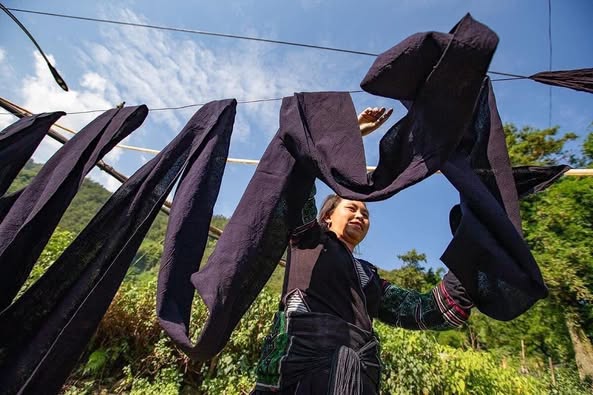

The unique indigo dyeing craft of the H’mong people in Sa Pa has been passed down through generations, and the deep blue hue remains a symbol of local culture. Along with the art of indigo dyeing, the H’mong in Sa Pa have also discovered various decorative techniques that vividly reflect their ethnic identity.
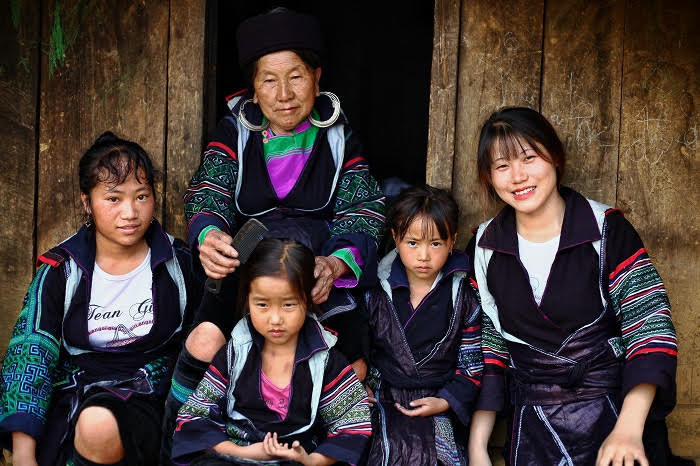
Indigo Color on Women’s Clothing
Living for a long time in the Northwestern and Northeastern mountainous regions, including Lao Cai, Lai Châu, Tuyên Quang, and Điện Biên, the H’mong have preserved many customs, especially weaving, embroidery, and making traditional costumes. To serve these practices, nearly all H’mong women of reproductive age know how to spin, weave, dye with indigo, and embroider intricate and delicate patterns that showcase their talent and dexterity.
In Sa Pa, the H’mong make up 52% of the population, residing in Tả Van, Tả Phìn, Ngũ Chỉ Sơn communes, and Sa Pa town. Notably, most H’mong women here have hands stained with indigo because it is their daily work.
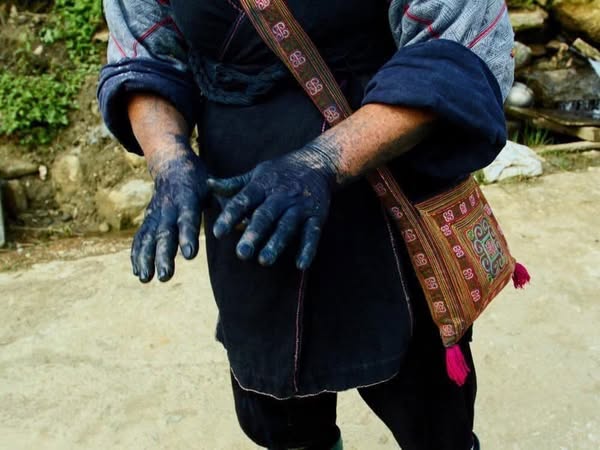
Hands Stained with Indigo
The technique of dyeing linen fabric with indigo leaves results in a deep blue color, a distinctive hue of the minority ethnic groups. This indigo dye is used by the H’mong to dye fabrics for their traditional clothing, passed down from generation to generation.
To prepare the dye, indigo leaves are harvested and soaked with clean spring water in large vats for three days. Then, they remove the residue and add lime, stirring for several hours until a yellow or greenish layer appears on the surface. When the indigo-lime solution settles at the bottom of the vat, they add quality charcoal ash, porridge, water, and alcohol, letting it sit for 4-5 days until bubbles form. The dye production process is then complete.
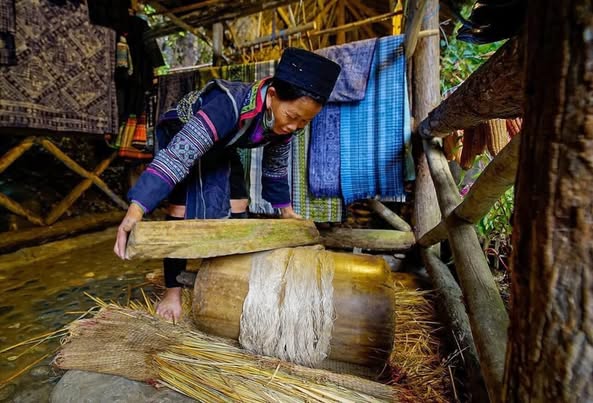
Rolling stone to soften linen fabric
The H’mong in Sa Pa grow indigo along hillside slopes. They use the leaves to produce dye through fermentation and oxidation. To create high-quality indigo dye, not only is the raw material important, but also the skill and experience of the dyers. The entire dyeing process takes about ten days, sometimes up to a month.
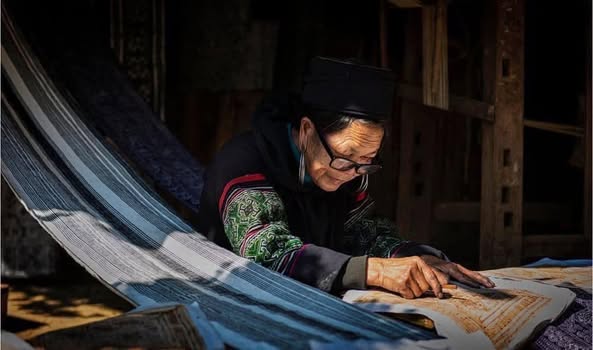
Drawing Beeswax Patterns on Linen Fabric
The H’mong create black fabric by repeating the dyeing process multiple times. This is also why H’mong women often have hands stained blue they work with their hands frequently. Finally, to give the fabric a shiny and beautiful appearance, they coat it again with beeswax. From there, H’mong women can freely decorate their fabrics with intricate patterns.
0 Comment